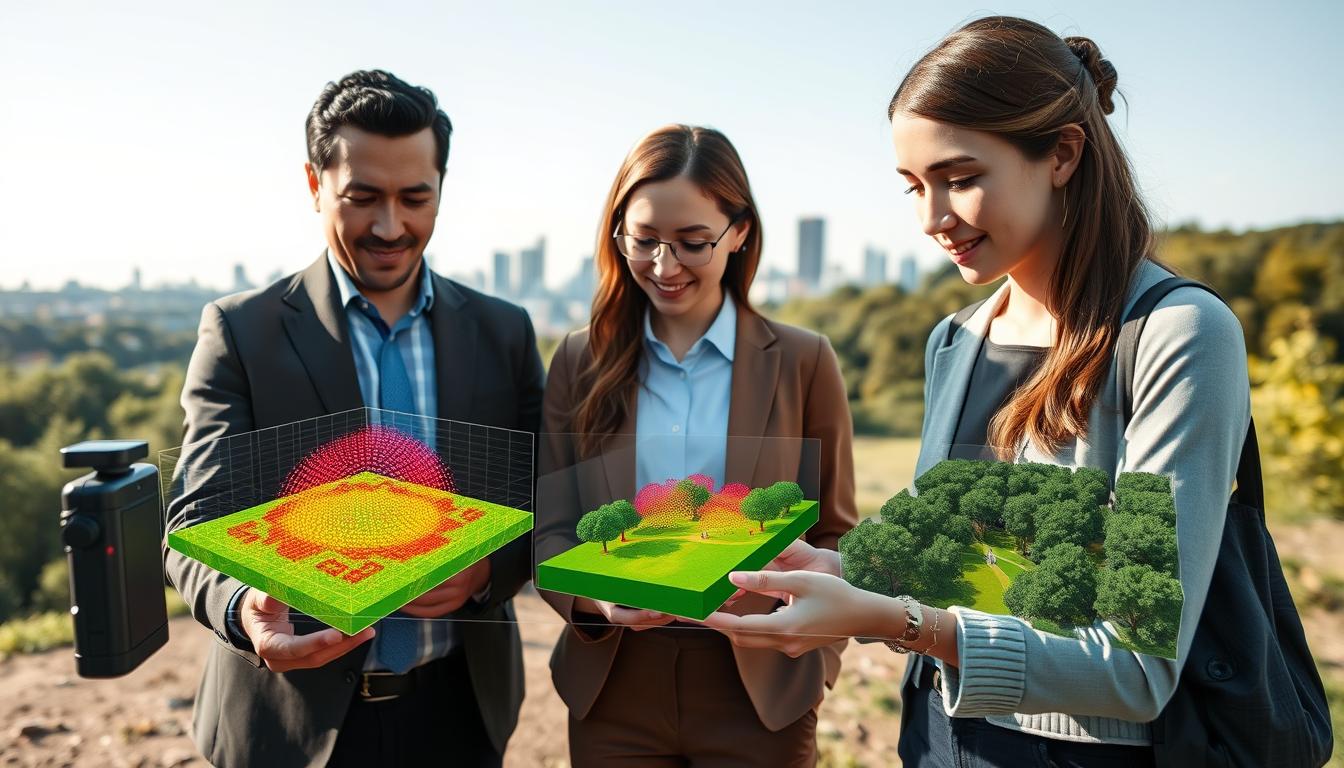
The world of 3D scanning and virtual reality is changing fast. This is thanks to LiDAR technology. In the last two years, LiDAR use in phones has grown by over 300%.
This change is big for industries like construction and architecture.
Now, devices like the iPhone and Apple Vision Pro have consumer-grade LiDAR. Android phones do too. This opens up new ways for 3D modeling and virtual reality.
Gaussian splatting apps make these tools even better. They help users make very detailed and accurate 3D scans. So, both pros and hobbyists are finding new uses for these technologies.
Key Takeaways
- LiDAR technology is becoming increasingly accessible on consumer devices.
- Gaussian splatting apps are making 3D scanning better.
- New uses are coming up in fields like construction and architecture.
- LiDAR use in phones has really grown.
- Consumer-grade LiDAR is making 3D modeling and virtual reality more possible.
What is Consumer-Grade LiDAR?
LiDAR technology is now for everyone, not just big companies. It’s smaller and cheaper, fitting into gadgets we use every day.
Definition and Overview
Consumer-grade LiDAR is for personal use. It’s not as big or expensive as the kind used in factories. Now, it’s in phones, tablets, and more, making things possible we never thought of.
Applications in Everyday Life
LiDAR in gadgets makes things like augmented reality (AR) better. It helps AR feel more real and fun. It also helps devices know where they are and where they’re going.
LiDAR is also great for 3D modeling. It lets us make detailed pictures of things and places. And it’s good for indoor navigation, helping devices find their way inside.
As LiDAR gets better, we’ll see even more cool things. It will make our tech even more fun and useful.
The Mechanics of LiDAR Technology
LiDAR technology works by measuring how long it takes for laser pulses to return. This lets it figure out how far away things are. It’s the core of what makes LiDAR work.
How LiDAR Works
LiDAR systems send out laser light. They then measure how long it takes for this light to come back. This lets them know how far away things are with great accuracy.
The steps are simple:
- Emission of laser pulses
- Reflection of laser pulses off objects
- Measurement of the time-of-flight
- Calculation of distances based on the time-of-flight data
Key Components of LiDAR Systems
LiDAR systems have important parts that help them work. These parts are:
| Component | Description |
|---|---|
| Laser | Emits laser pulses towards the target |
| Scanner | Directs the laser pulses across the area of interest |
| Receiver | Captures the reflected laser pulses |
| Processor | Calculates distances and creates a 3D representation |
Knowing about these parts helps us see how complex and powerful LiDAR is. Together, they help LiDAR systems give us precise and detailed information about space.
Introduction to Gaussian Splatting
Gaussian Splatting is a new way to make 3D scenes. It uses special math to show complex scenes. This is big for LiDAR tech, and even for phones.
Understanding Gaussian Splatting
Gaussian Splatting is a new way to make 3D scenes. It uses special math to show scenes. This makes scenes look better and faster.
This method breaks scenes into easy parts. This makes it fast and good for phones. Phones don’t have a lot of power, but this method works well.
Comparisons to Traditional Rendering Techniques
Old ways to make 3D scenes are slow and not as good. They use big chunks of data. But, they can be slow and not as detailed.
Here’s how Gaussian Splatting is different:
| Feature | Gaussian Splatting | Traditional Rendering |
|---|---|---|
| Rendering Quality | High detail, realistic | Variable, can be less detailed |
| Processing Speed | Faster, efficient | Can be slower, computationally intensive |
| Scene Representation | Gaussian distributions | Mesh-based or point cloud |
Gaussian Splatting Apps are changing 3D scenes on phones. They make scenes look better and work faster. This is great for games and work tools.
Benefits of LiDAR in Consumer Devices

LiDAR technology has changed how we move around and see our world. It makes devices like iPhones better at finding our way and showing us maps. It also makes augmented reality more real.
Enhancing Navigation and Mapping
LiDAR makes devices better at knowing where things are and how far apart. This helps create detailed 3D maps. These maps are useful for many things, like:
- Improved GPS navigation
- Enhanced indoor mapping
- More accurate distance measurements
For example, iPhone users get better at finding their way in new places. They also get more accurate location info from apps.
Improving Augmented Reality Experiences
LiDAR also makes augmented reality (AR) better on devices. It helps AR apps blend virtual objects with real life.
This leads to cool AR apps, like:
| Application | Description | Benefits |
|---|---|---|
| Gaming | More immersive gaming experiences | Enhanced user engagement |
| Shopping | Virtual try-on and product demonstrations | Increased customer satisfaction |
| Education | Interactive learning experiences | Improved knowledge retention |
LiDAR in devices opens up new ways to navigate, map, and use AR. It changes how we see and interact with our world.
Gaussian Splatting Apps for iPhone Users
Gaussian Splatting on the iPhone is changing how we make and use 3D models. The iPhone’s LiDAR tech lets developers make cool apps. These apps use Gaussian Splatting for 3D modeling and more.
Top Apps Available for iPhone
Many apps use the iPhone’s LiDAR tech. Here are some top ones:
- 3D Scanner App: A great tool for making detailed 3D scans with LiDAR.
- Scaniverse: An app for making 3D models and exploring with Gaussian Splatting.
- LiDAR Scanner: A simple app for scanning things and places with LiDAR.
These apps are known for their cool use of Gaussian Splatting and LiDAR. They offer lots of creative options.
Features and User Experiences
These apps have different features and user experiences. For example, the 3D Scanner App is easy to use and makes high-quality scans. Scaniverse has advanced tools for editing 3D models.
| App Name | Key Features | User Rating |
|---|---|---|
| 3D Scanner App | High-resolution 3D scanning, easy-to-use interface | 4.8/5 |
| Scaniverse | Advanced 3D modeling, editing capabilities | 4.7/5 |
| LiDAR Scanner | Accurate measurements, simple scanning process | 4.5/5 |
These Gaussian Splatting apps for iPhone are changing mobile 3D scanning and modeling. They give users many tools and features to be creative.
Best Gaussian Splatting Apps for Android
Android’s Gaussian Splatting apps change how we use our devices. They use LiDAR technology for advanced features. These apps make our devices more fun and interactive.
Leading Android Apps in the Market
The Android market has many Gaussian Splatting apps. Each app has special features and uses. Here are some top apps:
- 3D Scanner App: It’s great for precise scans. Both pros and hobbyists love it.
- LiDAR Scanner: It’s easy to use and scans well indoors and outdoors.
- Gaussian Splatter: It’s good for making and changing 3D models with Gaussian Splatting.
User Reviews and Ratings
What users say helps us know if an app is good. Here’s what they think:
| App Name | Average Rating | User Comments |
|---|---|---|
| 3D Scanner App | 4.5/5 | “Accurate and easy to use, a must-have for anyone interested in 3D scanning.” |
| LiDAR Scanner | 4.7/5 | “The quality of the scans is superb, and the app is very intuitive.” |
| Gaussian Splatter | 4.3/5 | “A powerful tool for creating complex 3D models, though it has a learning curve.” |
These Gaussian Splatting Apps for Android make our devices better. They open new doors in architecture, gaming, and education. As LiDAR tech gets better, these apps will too. They’ll offer even more cool features and tools.
The Role of LiDAR in Apple Vision Pro
Apple Vision Pro uses LiDAR technology to change how we see and interact with space. It makes data collection more precise and quick. This is key for better AR experiences.
Advanced Spatial Mapping
The LiDAR in Apple Vision Pro gives accurate depth sensing. This means it can map spaces very well. It’s great for making AR that feels real and works with your surroundings.
Enhanced precision in mapping opens up new ways to use AR. This could be in games or for work.
Professional Applications
In work, Apple Vision Pro’s LiDAR is changing fields like architecture and design. Architects can make detailed 3D models of buildings. This helps with design and planning.
“The use of LiDAR in Apple Vision Pro represents a significant leap forward in AR technology, giving pros a strong tool for planning.” – Industry Expert
Some main uses are:
- Improved visualization for architects and designers
- Better planning and doing projects in construction
- Deep spatial analysis for interior designers
With LiDAR, Apple Vision Pro is changing how professionals work and see their world.
A Dive into the Future of LiDAR Technology
LiDAR technology is getting better and will change many fields. It will make things more accurate and far-reaching. LiDAR will be key in the future of tech and its uses.
Upcoming Innovations
New things are coming for LiDAR. Better LiDAR hardware will pick up more details. This means LiDAR data will be more precise and detailed.
Software will also get better. New algorithms will make LiDAR data analysis faster. This is good for things that need quick action.
Potential Industry Impact
These changes will affect many areas. For example, in urban planning, LiDAR will help make detailed 3D city models. This will help plan and build better cities.
In the automotive industry, LiDAR will make self-driving cars safer and more efficient. It will give them the data they need to move around better.
| Industry | Potential Impact |
|---|---|
| Urban Planning | Detailed 3D city models for infrastructure development |
| Automotive | Enhanced safety and efficiency for autonomous vehicles |
| Environmental Monitoring | Accurate tracking of changes in land use and vegetation |
As LiDAR tech gets better, it will help in new ways. It will bring new ideas and make things more efficient in many fields.
Tips for Choosing LiDAR Apps
There are many LiDAR apps out there. Picking the right one for you is important. It can make a big difference in your augmented reality and navigation.
What to Look For
When picking a LiDAR app, think about these things:
- Accuracy: It should give you exact measurements and data.
- Compatibility: Make sure it works with your phone and LiDAR.
- User Interface: A simple interface makes things easier.
- Features: Think about what you need, like 3D modeling or augmented reality.
Here’s a table to help you see the differences:
| App Name | Compatibility | Key Features | Accuracy |
|---|---|---|---|
| LiDAR Scanner | iOS, iPadOS | 3D Modeling, Object Detection | High |
| Gaussian Splatter | Android, iOS | Augmented Reality, 3D Rendering | Very High |
| AR Measure | iOS | Measurement, Object Detection | High |
Common Mistakes to Avoid
Don’t make these mistakes when choosing a LiDAR app:
- Ignoring Compatibility: Make sure it fits your device.
- Overlooking User Reviews: Look at reviews to see how well it works.
- Not Checking for Updates: Updates can add new features and improve things.
By thinking about these points and avoiding mistakes, you can find a great LiDAR app. It will make your experience better.
Conclusion: The Future of Consumer-Grade LiDAR and Apps
The future of LiDAR and apps is getting more exciting. Technology is moving fast. We will see new uses for LiDAR soon.
Growing Importance in Daily Life
LiDAR is changing how we see the world. It helps with navigation and mapping. It also makes augmented reality better.
Advancements in Gaussian Splatting
Gaussian Splatting Apps are becoming popular. They let us see and interact with 3D spaces in new ways. As they improve, we’ll see cool uses in many fields.
LiDAR and Gaussian Splatting Apps will change electronics. We’re excited to see what they bring next.